Why Visual Aids Make a Big Difference in Patient Counselling
Every day, patients and their families walk into a cardiology clinic trying to understand things that can feel overwhelming — blocked arteries, stenting procedures, pacemakers, dilated cardiomyopathy, and long-term lifestyle changes. Medical terms are hard. Anxiety is real. And yet, good understanding is one of the most important steps toward good health outcomes.
At Backbone Medicity Hospital in Rajkot, Gujarat, Dr. Nikhila Pachani uses a simple but powerful approach: visual aids and diagrams displayed right in the consultation area.
A Picture Really Does Speak Louder Than Words
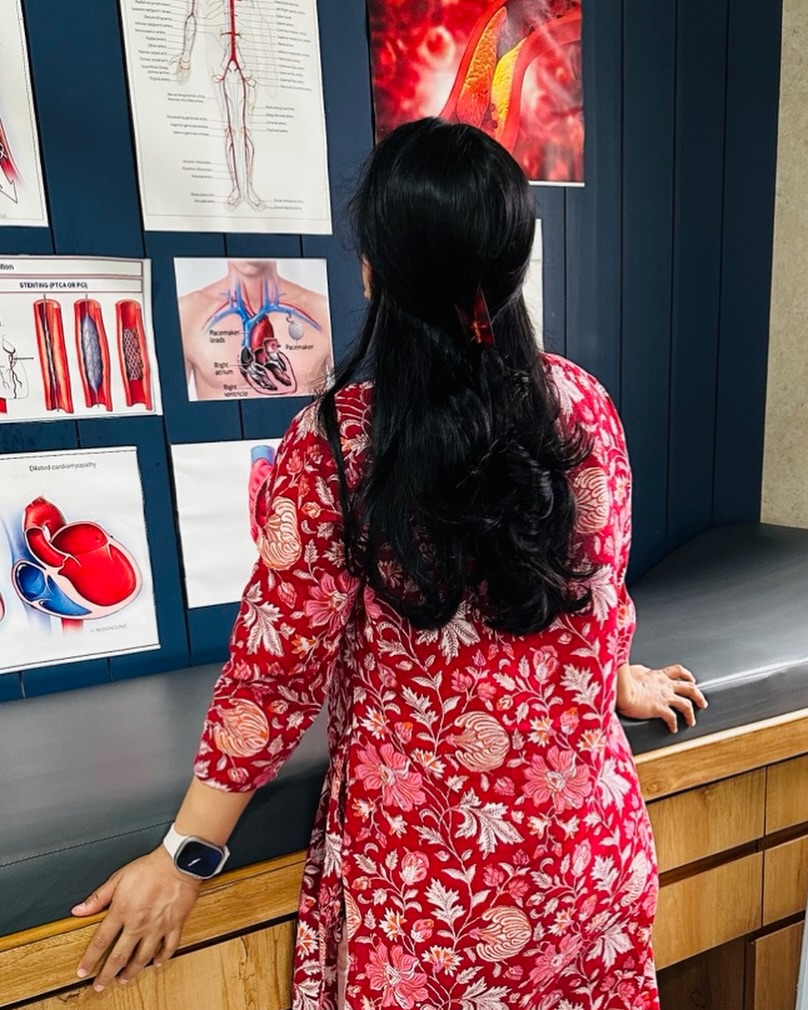
The image above shows a wall of clear, labelled medical charts — covering topics like coronary stenting (PTCA/PCI), pacemaker placement, dilated cardiomyopathy, and vascular anatomy. These are not just wall decorations. They are counselling tools.
When a patient can see what is happening inside their body — how a stent opens a blocked artery, or how a pacemaker connects to the heart — it becomes much easier to understand why a procedure is needed and what to expect.
How Visual Counselling Helps Patients
Research and clinical experience both support what good doctors already know:
- Understanding improves. When people see a diagram, complex ideas become clearer.
- Anxiety reduces. Fear often comes from the unknown. Seeing a visual explanation of a procedure can make it feel less frightening.
- Participation increases. Patients who understand their condition are more likely to ask questions and take an active role in their own care.
- Compliance gets better. When patients understand why they need to take a medication or follow a lifestyle change, they are more likely to stick with it.
- Trust grows. A doctor who takes the time to explain builds a stronger relationship with the patient and family.
Good Counselling Is Part of Quality Care
Quality healthcare is not only about procedures and medicines. It is also about communication. When a cardiologist explains a diagnosis using a diagram — not just medical words — it shows respect for the patient. It treats them as a partner in their own health journey, not just a bystander.
This is especially important in cardiology, where conditions like heart attacks, heart failure, and arrhythmias require both timely treatment and long-term lifestyle management. Patients who truly understand their condition are better equipped to manage it.
If you or a family member has any concerns about heart health, consider booking a consultation with a qualified cardiologist who can explain your condition and options clearly.